Go back
Achmed Esser — A Gallery of Living Systems

1180 votes
|
Website
Created by Achmed Esser / Bid Champions Ltd
Public voting is currently closed.
Overview
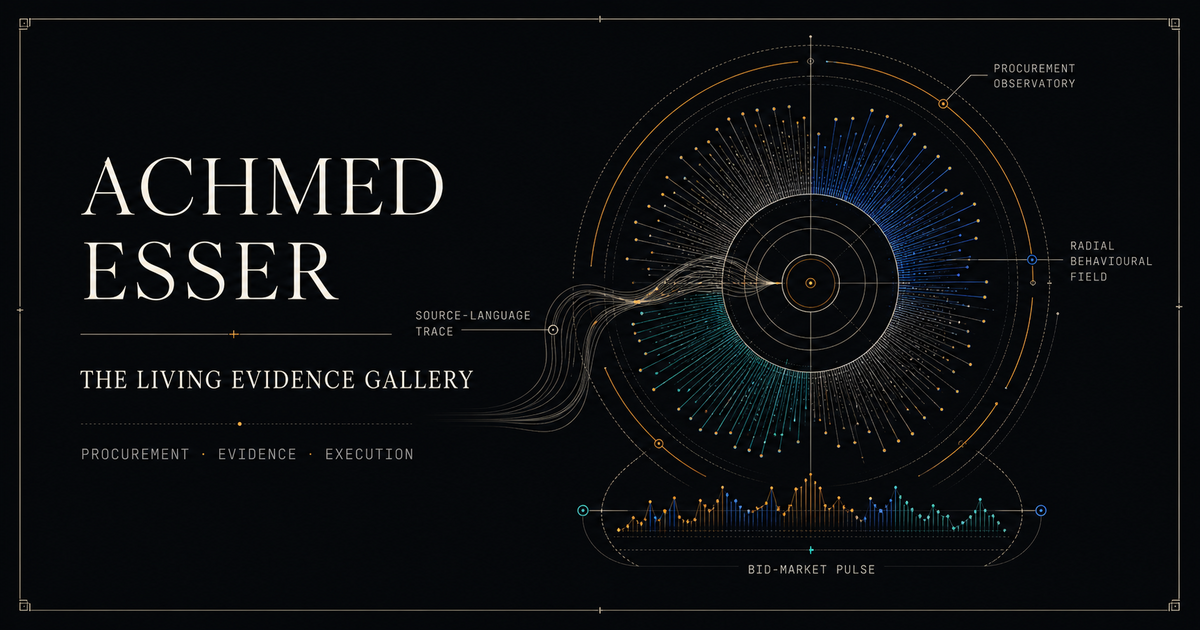
An evidence-led personal website that transforms procurement, tender evaluation and professional experience into a living digital gallery of paintings, clocks, decision rooms, playable systems and transparent source trails.
Project Details
Category
Website
Customer
Internal project — Achmed Esser / Bid Champions Ltd
Submitted by
Achmed Esser / Bid Champions Ltd
Timeframe
1 June 2025 and 31 May 2026
Tech Stack
Astro, semantic HTML5, CSS3, JavaScript, Canvas API, SVG, Python, Gemini language and image models, Git, JSON and RSS feeds, systemd automation and static fallback generation.
Services
Product strategy, creative direction, UX and information architecture, UI and interaction design, data visualisation, editorial design, frontend implementation, prototyping, automation architecture, accessibility and quality assurance.
Demo Link
-
Team
Single-person project led by Achmed Esser — product owner, procurement subject-matter expert, creative director, information architect, UX/UI and interaction designer, data-model designer, editor and final quality controller.
Link to case study
Description
THE INITIAL PROBLEM
Bid and procurement websites usually communicate expertise through service lists, credentials, case studies and enquiry forms. That format is efficient, but it hides the real character of the work: competitive decisions are living systems shaped by evidence, thresholds, risk, timing, institutional behaviour and human judgement.
Achmed Esser needed a personal website that could do more than present a CV or sell consultancy. It had to make more than two decades of bidding practice understandable and memorable; remain useful to professionals; show where evidence ends and interpretation begins; and create a credible path to Bid Champions Ltd without turning every page into an advertisement.
THE CONCEPT
The response was to design a gallery rather than a brochure. A Gallery of Living Systems turns procurement and competitive decision-making into a connected collection of explorable instruments. The interface is not decoration placed around bidding content: the visual metaphor carries the meaning.
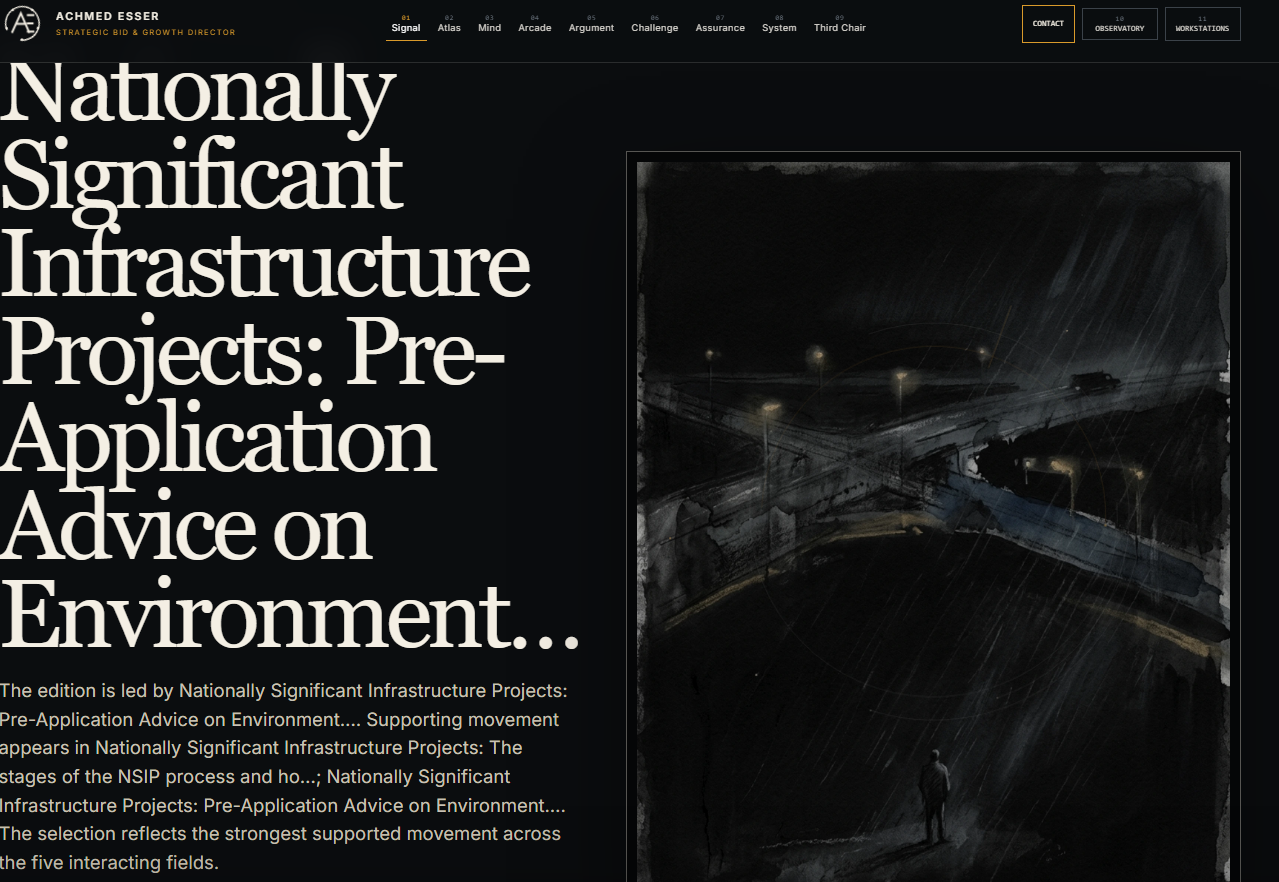
The homepage opens with Signals in Paint, where a sourced public-development packet becomes a daily visual composition. Behind the Canvas progressively reveals what changed, why it matters, source records, confidence and limitations. Visitors can start with emotion and then inspect the evidence.
The rest of the site becomes a sequence of rooms:
• The World Opportunity Clock turns public opportunity into a global temporal instrument.
• Tender Market Mood represents sectors as changing visual systems rather than a list of categories.
• The Precision Win System makes the end-to-end competitive process manipulable.
• The Procurement Mind makes observable decision pressures visible as institutional weather.
• The Evaluation Arcade turns 3,425 scoring configurations into reproducible rooms and a playable winner-flip mechanism.
• The Argument becomes a live decision room in which users choose a pressure, assume a role and see how an intervention changes the environment.
• The Art of the Challenge translates strategic literature into twelve ethical Wisdom Houses.
• The Champion System presents human preparation and performance as an operating system.
• Achmed Esser, Measured turns a conventional biography into a transparent numerical self-portrait.
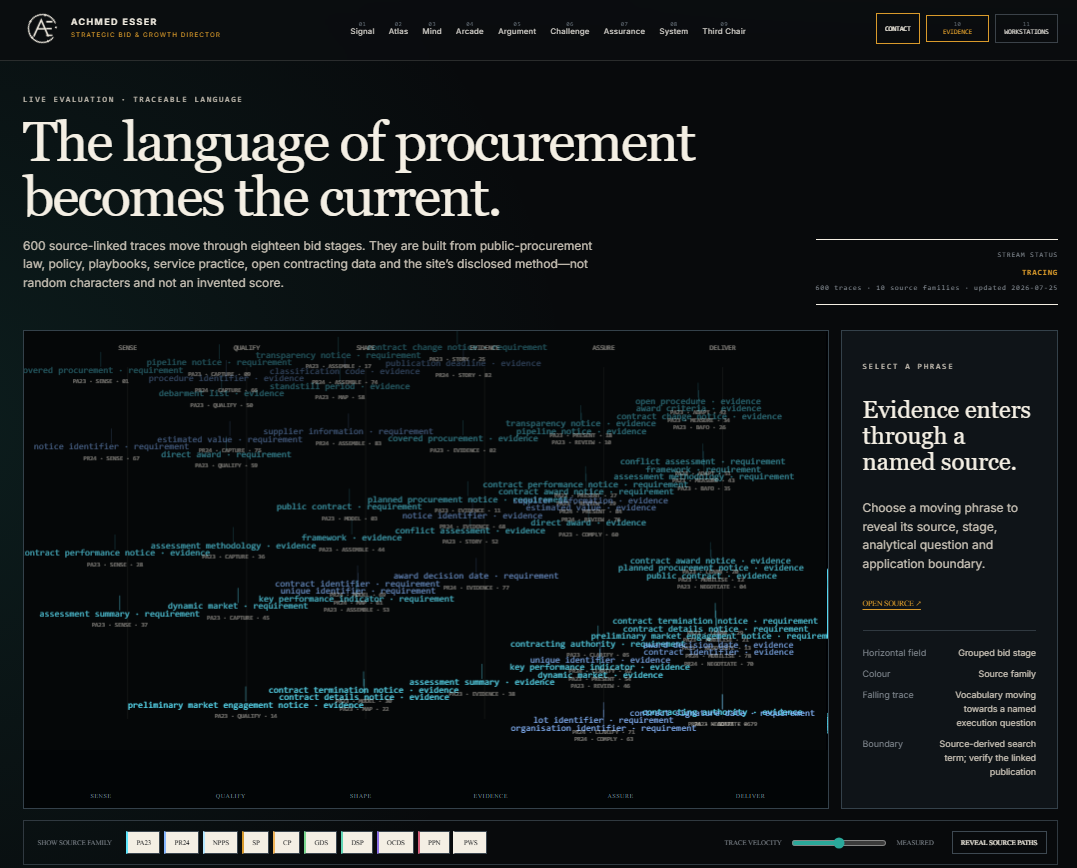
• The Evidence Ledger exposes the sources and truth status beneath the gallery.
THE PLAN AND USER JOURNEY
The UX plan had five rules.
First, create an immediate emotional and intellectual hook. Visitors see one strong signal and one artwork before they encounter a services pitch.
Second, use progressive disclosure. Every poetic or visual statement must lead to evidence, definitions, limitations or method.
Third, allow both linear and non-linear exploration. The navigation behaves like gallery rooms, while a connected journey moves from Signal to Mind, Arcade, Argument, System and the Third Chair.
Fourth, make complexity playable. Sliders, rooms, clocks, scenarios, time states and visual instruments let users test ideas rather than merely read claims.
Fifth, preserve user control. Motion can be set to Full, Calm or Still, and static fallbacks keep the experience legible without animation.
VISUAL AND INTERACTION DESIGN
The design language combines a near-black exhibition space, large editorial serif typography, compact monospaced instrument labels and restrained amber, teal, blue, rose and violet accents. Each room has its own visual metaphor, but the typography, framing, spacing and instrumentation create one recognisable system.
Canvas and SVG interactions make the site feel like a working laboratory without becoming a conventional dashboard. The homepage painting creates atmosphere; the surrounding labels, controls and evidence drawer turn that atmosphere into an inspectable system.
EVIDENCE AND RESPONSIBLE AI
A central design decision was to represent confidence and uncertainty rather than disguise them. Public states are separated into Observed, Derived and Experimental. Models are disclosed, experimental counterfactuals are not presented as predictions, and no interface claims to read a named evaluator’s private mental state.
The artwork pipeline begins with structured sources and publication thresholds. AI assists analysis, coding and image generation, but output is reviewed against rejection conditions, source boundaries and visual quality. When a provider is unavailable, a local procedural studio provides a controlled fallback. The project deliberately prefers an honest empty or qualified state to invented precision.
EXECUTION
The experience was built as a static-first Astro site using semantic HTML, CSS, JavaScript, Canvas, SVG and Python-supported data and publishing workflows. The build includes generated feeds, permanent archive states, page-specific metadata, a public Evidence Ledger and automated release checks. The static-first architecture supports speed, resilience and graceful degradation while still allowing substantial interaction.
ROLE AND TEAM
This was a single-person, AI-assisted project led by Achmed Esser. He acted as product owner, procurement subject-matter expert, creative director, information architect, UX/UI and interaction designer, data-model designer, editor and final quality controller.
AI coding and generative tools accelerated exploration and implementation, but the concept, user journey, factual boundaries, visual selection and release decisions remained under human direction.
OUTCOMES AND ORGANISATIONAL CHANGE
The immediate outcome is a shift from a static professional profile to an owned, repeatable publication and learning system. One evidence packet can become a visual edition, an archive state, an explorable explanation and a commercial conversation without weakening the distinction between editorial work and services.
The project now provides Bid Champions Ltd with a differentiated personal-brand doorway, a reusable framework for explaining complex procurement concepts and an extensible system for future evidence-led publications. Because the public launch is recent, mature traffic, engagement and enquiry metrics are not yet claimed.
LESSONS LEARNED
The strongest lesson was that visual originality is only valuable when it improves understanding. Metaphors had to remain tied to real procurement mechanics; otherwise they became decoration.
The second lesson was that generative systems require editorial restraint. Quality gates, source labels, fallback states and explicit uncertainty produced a more credible experience than attempting to fill every screen.
The third was that immersion and accessibility must coexist. Motion needs user control, complex rooms need clear labels, and a visually ambitious experience must remain understandable when animation is reduced or absent.
Finally, a personal website can function as a product. By combining subject expertise, storytelling, interaction and evidence, it can teach, provoke curiosity and create commercial trust without behaving like a conventional consultancy brochure.
Why Us
No bid/procurement website like this exists: a record-winning bidder transforms hidden tender wisdom into revolutionary art, playful systems, complex living experiences, revealing subjects the industry never revealed before in this depth.
https://achmedesser.com/