Overview
Silex is a free software visual editor for websites. It generates standard HTML and CSS, connects to any headless CMS, and publishes to hosting you control. You own the files and you own the tool, because Silex is a commons, not a product.
Project Details
Category
Web & Desktop App
Customer
None, Silex is free software. Studios use it for client work: Internet 2000 builds sites for Groupe Figaro, SCORE DDB, Eqwal and Surfrider with it. https://internet2000.net/realisations/
Submitted by
Silex Labs
Timeframe
June 2025 - June 2026 (maintained continuously since 2013)
Tech Stack
TypeScript, Node.js, GrapesJS, GraphQL, Eleventy, Tauri (desktop build), MCP server for AI assisted editing, AGPL-3.0 licence
Services
Product design, UX and UI design, front-end and back-end engineering, accessibility
Demo Link
Team
Alex Hoyau maintains Silex and leads development. Silex Labs, a French non-profit, runs the project. 31 people have contributed to the main repository, alongside designers, translators and community moderators.
Link to case study
Description
Silex is a visual editor for websites, and it is free software under the AGPL licence.
Most visual website builders ask you to trust a company. Your pages live in a format only that company can read, on servers only that company controls, under terms that company can change. When the company is sold or shuts down, your work goes with it. We built Silex on the opposite principle: the tool belongs to the people who use it.
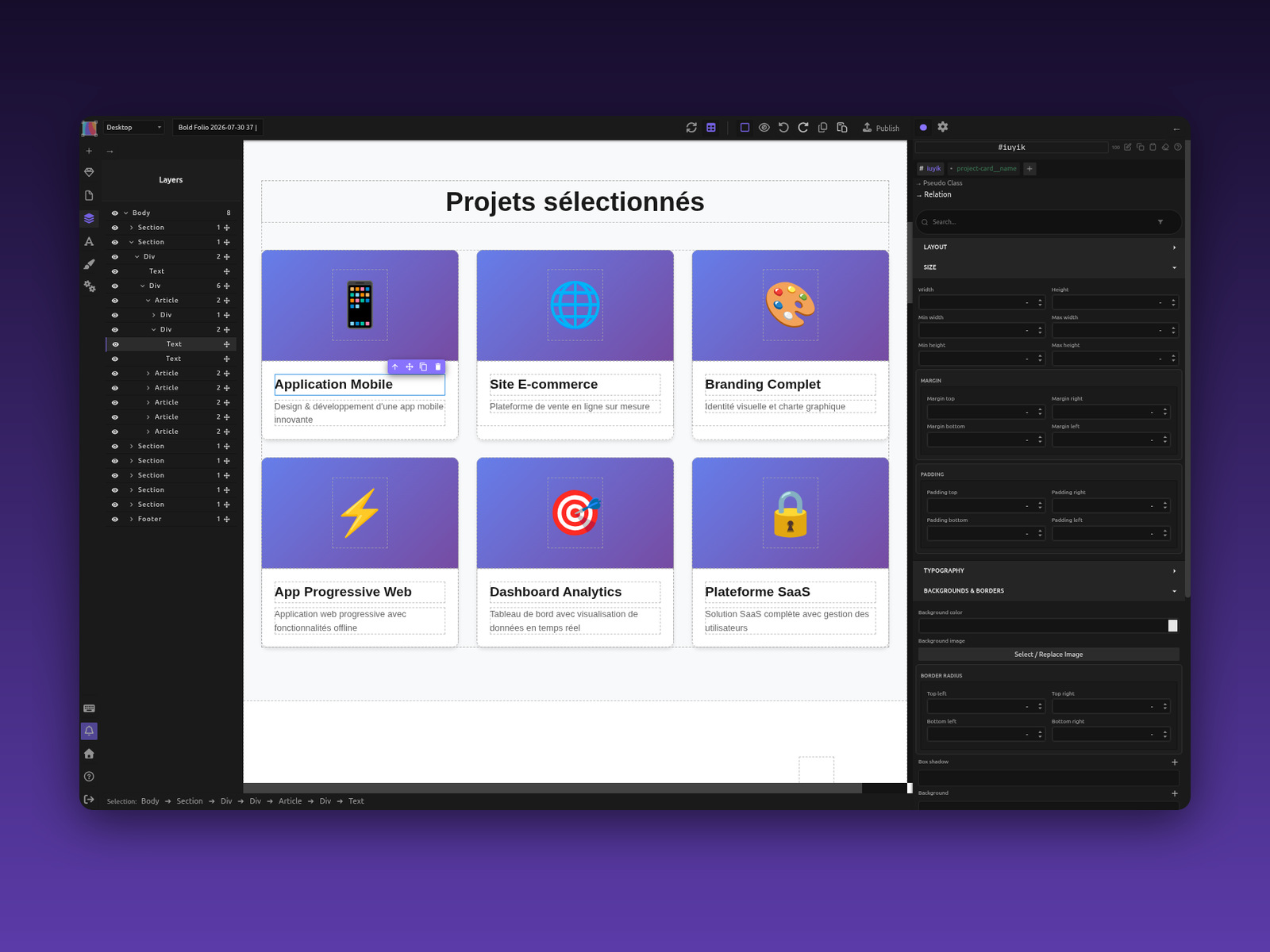
You design a page by dragging elements on a canvas, the same way you would in any modern editor. Silex then generates ordinary HTML and CSS files. There is no proprietary runtime, and you do not need an account on our servers. You can open the output in any text editor, put it on any host, hand it to a client, or move it somewhere else in ten years. Nothing about the format ties you to us.
Silex connects to any headless CMS through GraphQL, so a designer can bind a repeating element to a content collection without writing code. The result is still a static site: fast to serve, cheap to host, and simple to keep secure. Content authors update content in the CMS they already use, and the site rebuilds.
You can run Silex in three ways. Use the hosted instance at v3.silex.me, which is free and stores your work in a GitLab account you own. Install it on your own server, because the whole stack is public and the licence guarantees that right. Or run Silex Desktop, our local application built with Tauri, which works offline and needs no account. Silex Desktop is currently in alpha.
Silex Desktop also includes a bridge between AI tools and the visual editor, built on MCP, an open standard. Through it, any compatible AI tool can create and edit pages, content and styles, read the document structure, manage assets and data sources, and trigger builds. Silex does not bundle a specific AI: the bridge is the interface, and you plug in whatever you prefer. It runs locally, so nothing leaves your computer unless you choose to publish, and what the AI produces is the same HTML and CSS you would write by hand. It runs on ordinary hardware, with no GPU and no cloud dependency, because small language models are enough for web design. Less compute, less energy, more people able to run it. This part is an early prototype, and it is the direction we are taking Silex next.
Accessibility is part of the work, not an afterthought. We are improving the editor interface itself and the markup it produces, so that sites built with Silex are accessible from the start instead of being fixed afterwards.
Silex has been developed in the open since 2013 by Silex Labs, a French non-profit. It is a member project of OW2, and in June 2026 it won the Technology Award at the OW2con'26 Best Project Awards.
How it survived thirteen years is worth telling, because for most of them there was no money at all. Silex was kept alive by unpaid work: our own time, the web studio Internet 2000, which builds its client sites with Silex, and freelancers who gave their evenings. A few companies and sponsors helped at times, with no plan behind it. Since 2026 part of the work is paid for by the NGI0 Commons Fund, a fund established by NLnet with financial support from the European Commission's Next Generation Internet programme.
None of that money ever came from investors. There is no exit to prepare, so Silex cannot be bought and shut down. Every user who relies on it can fork it, host it, and continue it. That is the point.
Project Outcomes
Silex has been developed in the open since 2013. As of 27 July 2026 the main repository has 2,906 stars and 662 forks on GitHub, with 31 contributors. The main repository received 1,232 commits over the last twelve months.
The editor package was downloaded 13,141 times from npm over the last twelve months, and the data-source plugin 11,584 times. The hosted instance runs at v3.silex.me and is free to use.
The community meets on a public forum at community.silex.me, which holds 223 public discussions, and on Mastodon, where the project account at fosstodon.org/@silex has 290 followers.
In June 2026 Silex won the Technology Award at the OW2con'26 Best Project Awards in Paris, one of three awards given that year. Results: https://www.ow2con.org/view/2026/Awards_Results . Silex is a member project of OW2: https://projects.ow2.org/view/silex/ . The jury wrote that Silex "connects users directly to the open web ecosystem rather than confining them to a closed platform", and pointed to its community-driven roadmap, where publicly funded development follows user votes.
Silex is used in production for client work. The studio Internet 2000 builds its client sites with it, including the corporate site of Groupe Figaro, SCORE DDB, Eqwal Group, Hy24, Leasecom, Provepharm, OETH and the NGO Surfrider Foundation Europe. Those sites score A or B on EcoIndex, the French environmental rating for web pages, which is a direct consequence of Silex generating static pages. https://internet2000.net/realisations/
For most of its history Silex had no funding. It was carried by unpaid work: our own time, the web studio Internet 2000, which builds its client sites with Silex, and freelancers who gave their evenings to it. A few companies and sponsors helped along the way. Since 2026 part of the work is paid for by the NGI0 Commons Fund, a fund established by NLnet with financial support from the European Commission's Next Generation Internet programme: internationalisation, accessibility work, a move to a free software code hosting platform, and the desktop application.
Target Audience
Designers, freelancers and small agencies who build websites for clients and want to keep control of what they deliver. Non-profit organisations, schools and public bodies that need a website they can host themselves and maintain for years. Developers who want a visual editor they can extend, self-host and audit.
Why Us
Silex proves a visual editor can belong to its users. Thirteen years old, carried by a studio and by volunteers long before any grant, with no investors and no exit. You keep your files, your hosting, and the tool itself.
https://v3.silex.me/
Explore More
Previous Editions
Category
Web & Desktop App